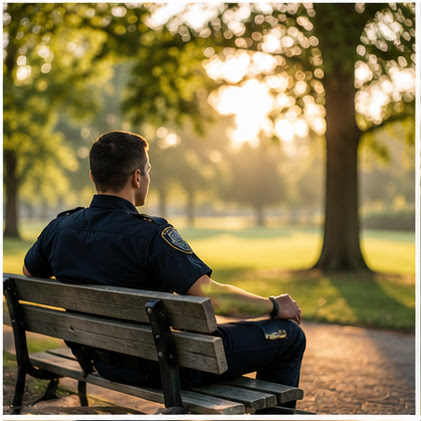
The Stories Behind the Statistics
The Stories Behind the Statistics
I Was a Statistic and Didn’t Even Know It
For fourteen years, I was one of those statistics. I didn’t know it at the time. After my LAPD detective father was murdered, I lived with undiagnosed PTSD. I was a number in a category I couldn’t even name. I was a walking, breathing example of the trauma that this life can inflict, and I was completely on my own. My experience is why I look at the data on first responder mental health statistics and I don’t just see numbers. I see people. I see stories.
And that’s what this is really about. It’s about looking past the percentages and seeing the human beings behind them. It’s about understanding what that pain actually looks like in a real life, in a real family. Because I believe that when we finally start talking about the stories, we can start to change the ending for so many people who are suffering in silence, just like I was.
The Sobering Numbers We Can’t Ignore
When I speak to departments, I sometimes see the leaders look at these numbers as a problem to be managed. But for the officers in the room, these aren’t just numbers. They are their friends. They are their partners. They are the person they were at the academy with. And sometimes, they are the person they see in the mirror. I know that feeling. I lived that feeling.
First responder mental health statistics reveal a significant crisis. Studies show that police officers and firefighters are more likely to die by suicide than in the line of duty. Around 30% of first responders develop behavioral health conditions like depression and PTSD, compared to 20% of the general population.
These are the numbers people talk about, but I want to talk about what they mean from my lived experience.
About 1 in 4 police officers have thoughts of suicide at some point in their life. What I know is that this number represents a profound hopelessness. It’s the feeling that the darkness will never lift, that the trauma has won. It’s a feeling I understand in my bones. And it’s a feeling that can be healed, but only if we are willing to face it.
Studies suggest that between 15% and 30% of police officers have PTSD. I believe the real number is so much higher. So many are like I was, suffering without a name for it. They think the anger, the nightmares, and the distance from their family is just part of the job. But it’s not. It’s the trauma, and it’s treatable.
The divorce rate among police officers is often cited as being significantly higher than the national average. We can call it the cop divorce rate, but what it really is, is the ripple effect of unhealed trauma. It’s the spouse who feels shut out. It’s the kids who are walking on eggshells. It’s the slow erosion of a family because the job is eating someone alive from the inside out.
These aren’t just police officer mental health statistics. They are evidence of a deep and systemic failure to care for the people we ask to care for us.
Why the System Trains Us to Become Statistics
So why are the numbers so high? Why does this keep happening? I’ve spent years thinking about this, living this, and talking to hundreds of officers. And I believe the answer is simple. The culture itself trains people to become statistics.
From the very beginning, in the academy, officers are taught to be strong, to be in control, to show no weakness. And this is how compartmentalization starts. They are taught to take all the horror, all the stress, and all the trauma they see on a single shift and put it in a box. They are told to lock that box and not let it affect them when they go home.
But it’s a lie. It doesn’t work. That box always, always leaks.
I did it for years. I put the grief and the trauma of my father’s murder into a box and tried to pretend it wasn’t there. But it came out anyway. It came out as anger. It came out as anxiety. It came out as a feeling of being completely disconnected from everyone I loved. And it’s the same thing I see in law enforcement today. The system trains officers to bury their trauma, then shames them for needing help when they can no longer keep it buried.
So when we look at the high rates of PTSD, burnout, and suicide, we have to understand that these aren’t individual failings. They are the predictable outcome of a system that tells its people to ignore their own humanity. We are creating these outcomes by telling people that their pain is a weakness. And we will keep getting the same results until we change that message.
Healing is How We Change the Story
For a long time, I thought my story was just about pain. I thought that was my identity. The daughter of a murdered cop, the woman who couldn’t get her life together. But then something shifted. I finally found the right person to help me, someone who saw my story not as a tragedy, but as a source of strength. And that’s when my healing began. It saved my life.
I believe healing is the ultimate act of strength. It takes more courage to face your own pain than it does to face a suspect with a gun. It takes real strength to say, “I am not okay, and I need help.” That is not weakness. That is resiliency. That is hope.
And when one person starts to heal, it creates a ripple effect. I’ve seen it happen. An officer who gets help stops yelling at his kids. He starts talking to his wife again. His partner sees the change and realizes that maybe he can get help, too. A sergeant who is open about his own struggles creates a space where his entire team feels safe enough to be honest.
This is how we change the story behind the statistics. It’s not about a new program or another wellness checklist. It’s about a fundamental shift in culture. It starts with one person, one story of healing, that gives another person permission to find their own. It’s about showing people what healing looks like on the other side. My entire purpose is built on this belief. It’s built on my own lived experience that there is always a path to resiliency and hope.
Frequently Asked Questions
What percentage of law enforcement officers suffer from PTSD?
While official numbers vary, most studies suggest that around 15% to 30% of police officers have symptoms of PTSD. From my lived experience, I believe the true number is much higher because many cases go undiagnosed or unreported due to cultural stigma.
Which first responder has the highest rate of PTSD?
Different studies point to different groups, but police, firefighters, and paramedics all experience PTSD at rates far higher than the general population. The critical point is that all first responders are exposed to significant trauma and are at high risk without proper support.
What is the divorce rate for police officers?
The divorce rate for police officers is often reported to be higher than for the general public, sometimes as high as 60-75%. This reflects the immense strain that unhealed trauma and job stress place on relationships and families.
How does trauma impact first responders?
Trauma impacts every part of a first responder’s life. It can lead to PTSD, anxiety, depression, and substance abuse, and it shows up as anger, isolation, and emotional numbness, which damages relationships with spouses, children, and friends.
Hope is More Than a Number
At the end of the day, we can talk about statistics forever. We can analyze the data and create new reports. But a report can’t sit with an officer at 3 a.m. when he’s thinking about ending his life. A number can’t give a family their father back.
The only thing that can do that is hope.
Every single number in every one of those reports represents a person. A person with a story, a family, and a future. A person who can heal. I know this because I am one of them. I went through the fire, and I found my way to the other side. My life is a testament to the fact that healing is possible.
So my mission is to change the culture, one story at a time. I want to create a world where every officer, every dispatcher, every firefighter knows that their pain is not a liability. It is a part of their story, but it does not have to be the end of it. Because there is always a path to the other side of trauma, and it starts with the simple belief that there is resiliency and hope waiting for you.
